Showing posts with label Philosophy. Show all posts

5/26/17

Lessons From: Ayn Rand's Virtue of Selfishness

How Ayn Rand viewed the necessity of freedom


Ayn Rand is an inflammatory figure and is frequently brought up in politics either by ultra-conservative Republicans who didn't get the point (or even read her books), libertarians who did, and libertarians who didn't, as an example of why their ideology is the one that works. At the same time, she's brought up by liberals who've never read Atlas Shrugged or The Fountainhead, as an example of why the others are not that bright if they believe that her philosophy is sound or that her writing is good. It's a hit and miss, for sure, but there are a lot of lessons you can get from her. If you know about Bioshock's background, then you know that the storyline of Rapture is based off Atlas and shows the danger of taking it too far.

The interesting thing about Rand is that she's practically a refugee that fled to the United States from the Soviet dictatorship. This means that if you want an example of somebody who's seen the horrors of communism, Marxist thought and postmodernist thought, there you have it, and having seen such a flawed reality of the communist ideology, she practically had no choice but to resent it, and thus was a pretty stern individualist.


Her Virtue of Selfishness is a collection of essays which explained her philosophy, Objectivism. This philosophy consists of reality's existence in spite of consciousness. In other words, she takes the age-old question of whether a tree really falls in the woods if there's no one around to see or hear it, and she pretty much takes a dump over it because regardless of anybody being there, the tree will fall because it's happening.

Objectivism also goes into morality, explicitly stating that man's moral purpose is to pursue his own happiness and the only socioeconomic system that will allow this is laissez-faire capitalism. This is why a lot of libertarians identify with Ayn Rand, they want a system as close to a truly free market as possible with minimal government intervention, in order to not have their individual rights threatened by any institution. This means that you can produce what you want, sell it to whomever you want, with whatever standards you have. As a customer, this also allows you the freedom of choice, and this seems to be threatened on both sides because the freedom of choice implies the freedom of discrimination, of having standards. The same way you can't just up and open a bar without getting a license to sell liquor in developed countries, you aren't really free to choose your religion in places like Egypt, where you can legally convert to Islam but not to any other religion.


Then, we have to wonder, what does Rand mean when she talks about selfishness? It's usually a derogatory term, after all, and one who praises the selfish is usually pretty egotistical himself. Thus, the term must be understood as "concern for your own interests", and when this is held back from the individual, it is when evil is manifested. If you're wondering whether this means one is not capable of loving another, then you have to realize it's not like that either. Ayn Rand was married to a designer who tried becoming an artist, who was living off royalties from his past works, and when asked whether she would need to help him stay on his feet were money to stop flowing into his pockets, she replied that not really, because she'd be doing it out of her love for him and it would give her immense pleasure that would be self-gratifying for herself.

To take an example from her fiction, in Atlas Shrugged the producers are burdened with the weight of the world on their shoulders, not only with taxes and regulations but the demand that all must be shared, after all, it is man that holds his brother up. Her heroes reject this because they refuse to live for another, only for themselves, and so they leave everything behind and create their own society in which everybody is equal and free, and nobody is obligated to live for another. It's a very utopic vision, for sure, but there is an interesting lesson to be learned about society's entitlement and resentment towards those who actively look out for their own interests. This is not to say that they wouldn't be fair or even charitable. Some of these men actively improved humanity with their inventions, innovations, discoveries, what have you, and there's even a banker who refused to loan money to people who wouldn't be capable of paying it back, which, if I may remind you, was a big factor of the 2008 crisis in the first place.


What can we learn from this? 

Objectivism is pretty simple to apply if you can understand that altruism is definitely a virtue you can have, but you can never place your love of another over the love of self, that is what cripples individuals and in the long run cripples societies. You may ask how it is that Bill Gates can dedicate most of his wealth to charity, then, and to that the answer is that he's pretty much covered, as well as his family, and they have more than enough money to last themselves a few generations, even with all they have donated. 


It's a pretty Aristotelic way to view the world, for sure, centering yourself in what's reality instead of the interpretation of what it should be, and acting according to that, and if you want to lead an existence that is both moral and practical, you wouldn't regret checking her philosophy out. I'd suggest reading Anthem, though, instead of Atlas or The Fountainhead. It's a pretty quick read and has most of her ideas. 

You can read Anthem here:

5/15/17

Lessons From: The Socratic Method

How Socrates learned and taught the truth

Shoutout to all the teachers


If you've taken a class with a good teacher, and you actually feel that you got something away from it, chances are that your professor used maieutics, or the Socratic Method. All in all, it's pretty simple, you have two or more people asking each other questions, and through these questions you stimulate critical thinking and actually view everyone's prejudices and can draw them out, or to further their understanding about any topic. 

In a way, it's also a method of eliminating hypothesis, because you're always finding better theories about anything, and getting rid of those which are contradictory, either with the truth, or with your other beliefs. You make a series of questions that serve as tests of logic in order to help someone expand their knowledge or beliefs about any topic. Even though Socrates was who developed this method, it is Plato who put it down in prose in the Socratic Dialogues, where he recorded conversations between his teacher and citizens. In these, the people were questioned on moral and epistemological (theory of knowledge) issues, and their views would be either challenged or expanded upon by the questions that they had to answer. Plato then developed another version of this method he called dialectics. 


The method is pretty similar to the scientific method. It follows these steps:

  1. Make a common sense statement
  2. Find an exception
  3. Reject the statement if you found an exception
  4. Make a new statement that accounts for the exception
  5. Repeat until you cannot find an exception
The whole deal with this method is the capacity to question a single idea. Modern debate tends to be focused on the big picture, but when you throw everything in and don't really question each of those ideas, your arguments can be pretty deficient. The variety of answers that you can generate for a single idea is pretty impressive, and if you do it correctly, you can learn much more than from a two-sided debate where people try to "win" with their ideas instead of having the right idea. 

There are two forms of this method. The Classic Socratic Method focuses on questions of morality, virtue, and the answers not known by the facilitator. The Modern Socratic Method asks questions that already have answers, and can be considered to be more of Plato's interpretation of his teacher's ways. While the Classic method will have you wondering whether justice is truly based in equity, the Modern method can be used to ask your student what 2+2 is and to gauge whether he can figure it out for himself. 


As you can see, the Modern method will have to be used a little differently than the Classic, for it is not the same to question beliefs than to actually acquire new knowledge through the questions that you are asked. For this, the questions must be  1) Interesting, 2) Incremental, 3) Logical (moving from the student's prior knowledge towards a goal), and 4) Designed to illuminate particular points. This makes the scope of answers that you can receive for your questions smaller than with the other method. Instead of simply asking what justice is, you give a small example of a moral dilemma and ask what is fair, and you build up from there. 

How can we apply this?

The Socratic Method is not only useful for a teacher, but for anybody who wishes to have a more objective view of the world. It implies that you use your critical thinking skills to debunk your own preconceptions, and get closer to the truth, which is what matters at the end of the day.


If you're a teacher, though, instead of simply asking your students to memorize information, lead them to it through relevant questions that they can answer for themselves if they think a bit. Should it be used to teach anything? Not quite, I wouldn't say it's effective for teaching somebody differential calculus if he's just finished linear algebra, for building knowledge on a new topic like that would take more time than it's worth. Use it to build knowledge rather than teach from scratch, and you'll have a powerful tool at your disposal. After all, the best teacher in history used it, why shouldn't you?

5/14/17

Lessons From: Aristotle's System of Logic

How to use Aristotle's Logic to be a better student


Teacher's Day is tomorrow here in Mexico, so before we indulge in learning about the man who possibly was the greatest teacher of all time, we will learn about Aristotle, a student of Plato,  who himself was a student of the aforementioned teacher, Socrates. Besides being one of the most prolific students Plato had, having created the first comprehensive system of Western Philosophy, and when he left his teacher's academy at the age of 37, he was requested by Phillip II of Macedon to tutor his son, Alexander the Great. Being a teacher, in fact, gave him many opportunities and supplies, with which he opened a library in the Lyceum, and although a big part of his monument was devoted to his teacher, he eventually left Platonism for empiricism, and indeed, he was one of the first to attempt to develop a scientific method, and many of his findings couldn't either be confirmed or rejected until into the 19th century. His teachings on ethics were pretty much influential in Judeo-Christian philosophy, but were eventually ignored due to the rise of Kantianism and other philosophies, but we can talk about virtue ethics in another time.


Today we will see a version of Aristotle's system of logic that will be pretty easy to understand, and once you do, you'll be able to apply it to your life. He believed that logic was the instrument we used to understand anything, and he developed what was known as categorical logic, widely accepted throughout even the 19th century, in which he asserted that the way we use the subject-predicate form is the primary expression of truth, and the way we use language can eventually be used to paint a picture of the world.

Using the Categories

In Categories, he establishes three ways that predicates can relate to each other in meaning: homonymy, synonymy, and paronymy, sometimes written as equivocal, unequivocal, and derivative. As you can predict, homonymy implies entirely different explanations, for example, "His wife cheated on him, he's pissed," and "He's had too much to drink, he's pissed." Synonymous is basically using the same predicate with the same meaning, like "Paintings are pretty," or "Statues are pretty." Paronymy is when one predicate branches out from the meaning of another, for example, "He is very well-learned," and "His knowledge of Aristotelian logic is that of a well-learned man." (That's going to be you by the end of this post).


These relationships between predicates are important when you relate them to the ten categories of things. The most important is substance, for it describes the thing in itself, and is separated into primary substance, which is the individual thing itself, and secondary substance, which is the species or genera in which the individual thing belongs. The other nine are quantity, quality, relative, where, when, being in a position, having, acting on, and being affected by, and their function is simply to describe what separates this individual substance from the others. Basically, the first step to thinking logically like the man himself is being able to actually describe the world that you're living in, and although the focus is universal, the universe is found in the particulars.

Plato points to ideas, Aristotle is grounded in reality

Because what you see is generally a result of your perception, and not the thing in and of itself, if through the Categories you can create various propositions about an object which combines or separates its concepts, and these actually correspond to the object itself, you can say that you've made a truthful statement. If you can correctly apply the categories, you can make logical deductions of the world around you, as all knowledge, acording to Aristotle, comes from what is already known. Say, for example:

  • All humans are mortal
  • All Athenians are human
  • Therefore, all Athenians are mortal
  • All dogs are mammals
  • All mammals have fur and breastfeed
  • All dogs have fur and breastfeed

How can we apply this?

It's pretty simple. If you were to summarize what Aristotle said in a sentence, it would basically be: Name things as they are and build on it. This also helps you create false assertions, for through the use of logic, you cannot simply invent a fact nor attribute characteristics to an object that it does not really have. All in all, knowing this will at least let you pay attention to the language you use to describe the universe, so you may avoid mistakes or inconsistencies, and thus, allow you to become an excellent student of the world. 

Read more about Logic here:

4/28/17

Lessons From: Marcus Aurelius' Meditations

How to use stoicism to get rid of your negative emotions


Marcus Aurelius Antoninus Augustus was emperor of Rome and the last of the Five Good Emperors. He was beloved during and after his reign and was generally considered to be intelligent and wise, having dedicated his life to studying what was known of the natural sciences, the arts, and philosophy, which he was eager to learn. He even slept on the floor until his mother stopped him from doing so. 

He is considered one of the greatest stoics, despite the fact that he never called himself one, and he kept a journal while on military campaigns for ten years which he called To Myself but is popularly known as his Meditations. It's not really organized by themes, but is more of a collection of thoughts which he would write down every now and then, and still it is considered one of the greatest works of philosophy to exist. 

Meditations itself is divided into 12 books, and is pretty straightforward and written pretty much so anybody could understand it, which reflects his nature of dressing like philosophers would instead of carrying himself in the emperor's garments. In this post we'll focus on his ideas on perspective, and how to use them to have a more tranquil mind. 


Everybody will run into terrible people from time to time, and sometimes that can ruin the whole day for you, but you must realize that life is too fleeting to focus on this. Anger deteriorates the mind, and yet the mind is the most important part of your existence and letting it be a slave to reactions and selfish passions, or letting it be injected with fear of the present or anxiety about the future is a waste. Sure, you can't tell where you're going to be in five years, or one, or even tomorrow, but you can keep your mind calm and do the best with what you have, whether you have nothing but yourself or the world as your oyster. 

Remember, too, that there is always solitude in the mind so you might as well learn to deal with it, and that you should not worry too much of what others think of you because you cannot control it, and it is not as much as you usually would presume anyways. Still, to avoid any bad impressions, think and act like you would want to be seen thinking and acting, and live with virtue, for the pursuit of good will leave you with a mind unburdened with guilt or shame and will let you focus on actual personal growth. 


Be aware of your judgement of self, because you must love yourself best and value your self esteem above that of others, with the caution of not letting it get over your head. Generally negative emotions, especially if left to ferment and grow, will lead you to underestimate yourself and undervalue your actions. It would still be wise to underestimate yourself, not from a position of weakness, but from a position of acknowledging that other people can have great capacity as well, but overvalue your actions while being humble so you are not taken advantage of. 

How can we apply this?

There's a reason stoicism has remained popular throughout the millenia, and that's because it's probably the most practical philosophy that there is. In modernity it's pretty much Buddhism and Taoism without the religious aspects, although there were some metaphysical thoughts thrown around back then, but these have been largely ignored with the advance of science and our understanding of the universe. 


If you're feeling a negative reaction to any situation, be it immediate or long-term, remember that it is not what happened that is affecting you deeply but your perspective of the event itself, and so you must allow yourself to let go of this and realize that there are always more important things to take care of so you might as well do so. 

Say a close relative died, they would not want you to suffer long for them and they would want you to live your life, for it is a privilege that they do not have anymore and if they could, they would realize it is precious. 

Say you've been dumped by your significant other, or worse, caught them cheating. Realize that it is no longer your problem and you must walk away both to protect your dignity and to begin the transition to move on, and forgive yourself for feeling sad, because emotion is human, but do not allow yourself to dwell on it.

Say you've been fired for any number of reasons that don't have to do with you. Realize that you have skills and are therefore valuable and can promptly either find another job or create a company yourself, and if you are not skilled enough, then you must pull yourself up by the bootstraps and learn, so you can actually make something of value. 


This time of year is pretty complicated to handle for a lot of young people because they're usually in exams, and sometimes the amount of work you have to do is too much for them to deal with. Remember this: It's a big effort in a small amount of time and the fact that you even have the possibility to study and prove your knowledge puts you in a privileged position compared to most people, so chin up. The rest of the world will still be there when you're done, and if it won't, then you need to reassess your priorities. 

So it goes, generally you'll confront adverse situations and thus need a solution in one way or another, and dwelling on the bad will not let you focus on the good. Change the way you see the world, and the world shall utterly change for you. 

Read more about Marcus Aurelius here:

4/26/17

Lessons From: Heraclitus and Flow

How to understand change and adapt to it

Shoutout to Balbina. For her birthday I'll cover the origin of her favorite philosophy. 


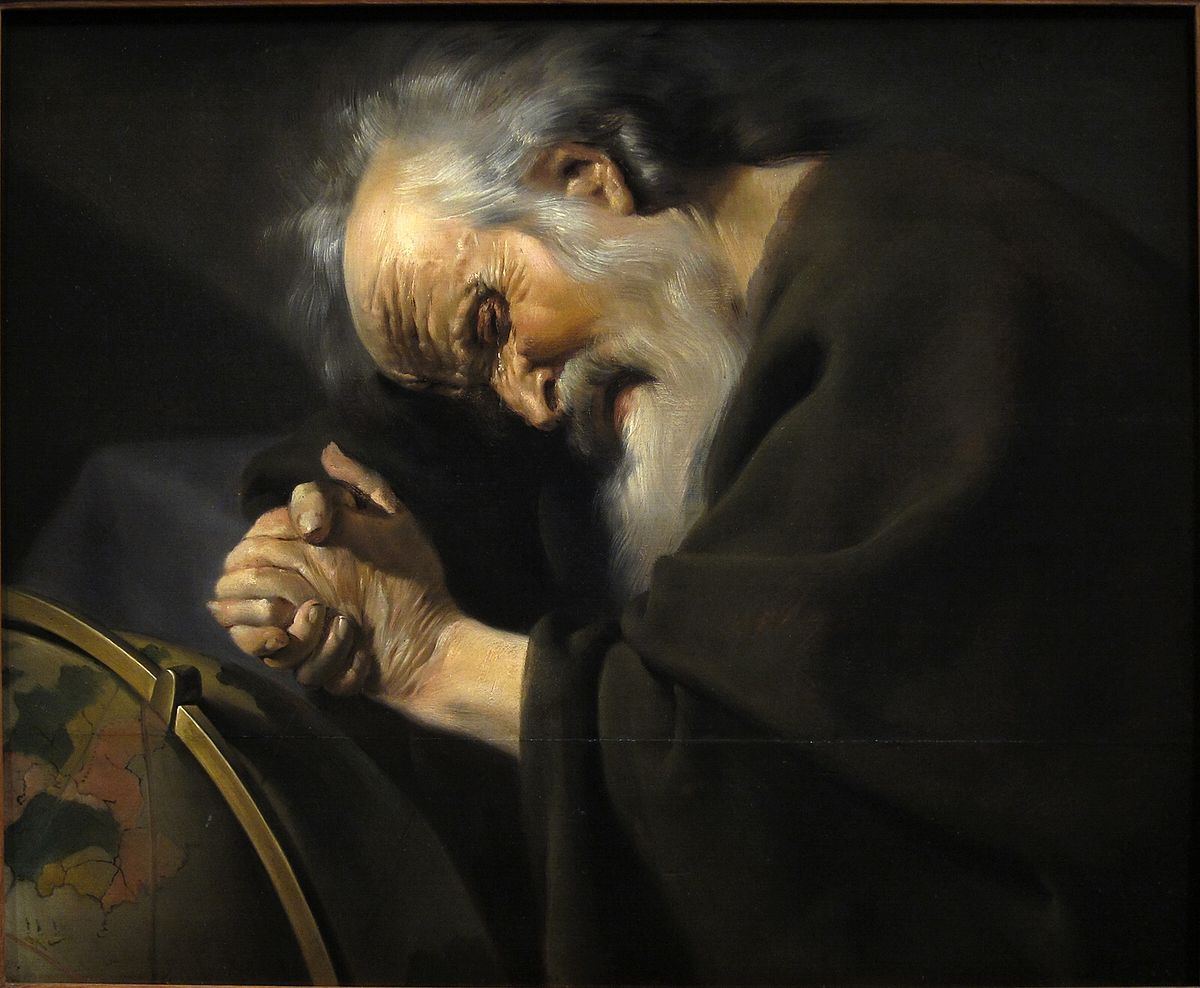
Heraclitus of Ephesus was one of those rare jewels that got to thinking about humanity's existence before Socrates came to be the wise leader of the youth in Athens. Not much is known about his early life, but he is said to have been self-taught, and truly a pioneer in wisdom and philosophy. You probably know his famous phrase: "A man never steps in the same river twice." Otherwise, you might know him as the Weeping Philosopher. 

He certainly was paradoxical, ever changing in his statements, saying he knows nothing, then he knows everything, he heard no one, but questioned himself, and he was all in all a misanthrope by the later part of his life. He decided to live a secluded life in the mountains, living off the land, and eventually he died of a disease incurable in such times. 


Although some of his philosophy was intentionally obscure so only the "capable" would understand it. This is the logos and understanding what the logos means is in and of itself a nightmare. Panta rhei, though, is significantly simpler and is where his fame comes from. Everything flows.

Ever-newer waters flow on those who step into the same rivers. 

All entities move and nothing remains still. 

Everything changes and nothing remains still, and you cannot step twice into the same stream. 

I will not say that the constant of change is the result of the cosmos moving the four elements across the universe in ever-flowing fashion nor will I say that it's the result of some universal energy that makes things happen. Energy exists, sure, and we use it, and the change is there simply because there are so many factors that affect the circumstances around you, and though you can control your inner self and your environment to some degree, you are still adapting to your circumstances and not they to you. 


Heraclitus also believed that flux was a result of duality, opposites that are attracted to each other and in a way two sides of the same coin. He said that the sea is pure and polluted, for the fish can drink and breathe in it but for men it is harmful. We are asleep and wake up, and we are awoken then go to sleep, so both qualities can be found in us, just not at the same time. Hitler loved dogs and drawing, but he also committed genocide. Mother Theresa spent her days helping the lepers, but at the same time denied them medicine for she believed in faith-healing. There is good and evil in everyone, in different times, even in the same day, and there are opposite qualities in everything. Does ice not burn if you hold it too long? 

What can we learn from this?

The ever-constant change in people and situations is not something that should surprise you. Look at a picture of yourself from six months ago. One year ago. Five, ten, you will notice that you have changed a lot, not only in image, but in how you are as well (maybe with the exception of incredibly stubborn people). 


You cannot control the change in others, and you cannot avoid the change in yourself throughout the days or ages, but you can allow yourself to adapt to the circumstances instead of letting your emotions get in the way. Of course, there are sad moments as well as happy moments, but you might as well avoid what Heraclitus did and be remembered by something else than weeping. 

Read more about Heraclitus here:

4/22/17

Lessons From: Schopenhauer's Will to Live

How to lose the "Will" to live to let go of suffering and live a happy life

Note before you begin: I know the subtitle is strange when the Will to live needs to be lost to reduce suffering, but when you get to the end of this article, you'll understand what Schopenhauer tried to say. 


Arthur Schopenhauer was a man greatly influenced by Immanuel Kant, considered by some to be the greatest philosopher to have ever lived. Post-Kantian thought was generally about a few key topics, including the idea that people are an end rather than a means, and critical philosophy, which was acknowledging our limits of understanding through philosophical thought. The movement was called German Idealism, which meant that properties we see in objects are a result of our perspective and not something which is necessarily in the essence of the object itself. Schopenhauer hated this. He was, in a sense, an Eastern philosopher in the West, supporting the notion that the world is what it is and he believed asceticism, which is abstinence from pleasure to focus on improvement a.k.a. "monk mode", was the way to go. 

His most important work, The World as Will and Representation, deals with what he considered fundamental to nature in general and humanity itself. We all have an insatiable Will to life, which is the source of both our ambition and our suffering. This is where his support for asceticism comes from; if you rid yourself of desire, you rid yourself of pain, and though this sounds pretty similar to Buddhism, it is not exactly the same, for this "wanting" is not considered part of human nature by those who adhere to that dogma. 


The first volume of the Will is split into four books. It is quite esoteric because you need to have a pretty good understanding of Kant's philosophy to understand what he wrote about. The first half of the volume deals with the world as an idea, and the basic gist of it is that our inner experience is the result of a manifestation of the world's essence, so to say. Electricity and gravity are said to be the forces of Will, and knowledge was invented to serve it be it in humans or others. The pessimism in Schopenhauer's philosophy can be seen here, for he says that unfulfilled desires are the cause of human suffering. 

Book 3/4 talks about genius, and Schopenhauer claims that everyone has a certain degree of it in one way or another, and this is what permits you to enjoy the aesthetic experience, or understanding what an object truly is in its platonic form and not the object itself. Anybody who could explain the aesthetic or display it was truly a genius in his eyes and music was, in his opinion, the most pure expression of the aesthetic because it showed raw articulation of the Will. 

Book 4 is about ethics, and supposed to be a descriptive account of our ethical behavior. There are two behaviors, the affirmation and the denial of Will. According to him, the essence of the Will is conflicted with the egoism in humans and animals, and transcending this egoism leads to compassion, a display of the possibility of leaving the Will behind. The Will can be released or denied but never changed, and he praised some forms of Christianity, Buddhism and Hinduism because of their asceticism, while having disdain for Protestantism, Judaism and Islam because of their optimism and cruelty. He also talks about suicide and doesn't see it as a destruction of the Will, but an affirmation of it, and asceticism, the denial of the Will, the individual may be weakened but will be saved from suffering, and he who has gotten rid of the Will has gotten rid of its hold on him and is nothing but a bad dream from which one awakens. 

What can we learn from this?

Again, this all goes back to asceticism. I won't tell you to get rid of your ego or desire for more, because I agree with Schopenhauer in that it's a part of human nature. What I will tell you is that if you let ambition consume you, you will suffer even after you achieve your goals because you'll suffer from chronic dissatisfaction. Instead, like I mentioned in Lessons From Amelie, simply take a breath, enjoy the little things and realize that there is no true endgame, so you might as well be happy while you build your future instead of waiting for that future to come. 

Read more about the Will here:

4/21/17

Lessons From: Plato's Virtues

How to apply Plato's 4 cardinal virtues to your code of ethics


Plato was an interesting man, to say the least. He is widely known for being a student of Socrates who went on to become one of the quintessential philosophers of Western canon, and even went beyond being a thinking man, instructed in grammar, music, and gymnastics as well. He was also a wrestler said to have competed in the Isthmian Games and was dubbed by his coach "Platon" for being broad. Whether this meant fat or strong, I cannot say, but the Greeks were very focused on fitness so I believe he was the latter. 

Plato, like many other philosophers of the time who looked to improve themselves and their fellow man, seeked eudaimonia, which is well-being achieved through excellence on account of good moral thought and conduct, and the tools for achieving these goals were called the virtues. In Republic, Plato established the four cardinal virtues as such:
  1. Prudence (Wisdom)
  2. Temperance
  3. Courage
  4. Justice

In order to understand these virtues and know how to apply them to your life, we will go through them one by one. 

Prudence (Wisdom)

The first of the virtues is prudence, the capacity to govern yourself using reason. Prudentia in Latin implies foresight, and although nobody can actually predict the future, the wise can tell what is virtuous and what is vicious in the given context of an action or situation. In modern times, prudence is also a synonym for cautious, but this is not the exact meaning of the virtue. 

In a sense, the capacity to tell what is good from what is bad is the most important of all the virtues, for it is the way you can find the others, and you need it to prevent your vices from overpowering you. 

What exactly constitutes prudence? Knowledge is pretty important, but you can know just about everything and be unwise. Experience is also important, for situations you have lived in the past can be a good point of reference in similar predicaments. Common sense is vital to wisdom, for many times complex problems are created from simple ones and can oftentimes have simple solutions themselves. 

How to apply it

There's no real guideline on applying wisdom, but before you make any decision you must stop and think. A few questions that can help you are:
  • Am I doing good by taking this decision?
  • Is this the smart choice?
  • Would I like to be treated like I am treating the other?
  • What are the consequences?
There's a joke about a man who is offered by some sort of magic either one million dollars or to become the wisest man in the world. After thinking for a minute, he chooses the wisdom, and when his friend asks him what he's thinking, he replies, "I should've taken the money." Had he asked himself if that was the smart choice, he surely would've chosen differently. 

Historically, there are many people who are considered extremely wise. Socrates was one of those, for in his denial of being a knowledgeable man, he prevented any humiliation if his knowledge was proven wrong. Siddharta Gautama, the first Buddha, was also considered wise for he let reason dictate his decisions, not his ego. Confucious said that wisdom could be learned in three ways: By reflection, which is noblest; by imitation, which is easiest; and by experience, which is the bitterest. If you look at the lives of these men, you will see that applying wisdom is all about stopping to think before you act. 

Temperance (Restraint)

The only way you can prevent a vice is with a strong willpower that will hold you back. As they say, moderation is the key. This can go from substances like drugs and alcohol to not allowing your emotions to take control of you, manifested in non-violence and forgiveness. 

In most esoteric philosophies you will see the notion that letting your desire for anything take control over you will take you away from the path to virtue, nirvana, heaven, or any other representation of the ideal world. 

There are multiple areas in which you can exercise temperance, and if you succumb to your hunger without moderating yourself in any of these, you will see dire consequences. 
  • Thought - Vice can lead to extremism or self-induced depression
  • Physical - Vice can lead to eating disorders, obesity or even self-mutilation
  • Sexual - Vice can lead to hedonism and disease
  • Humility - Vice can lead to arrogance
  • Forgiveness - Vice can lead to resentment
  • Mercy - Vice can lead to cruelty

How to apply it

The trick with temperance is to look at your own life objectively. If you're wasting your days on a couch watching T.V. or surfing the web, if your scale is going up and your clothes get tighter, if your mind seems to be on a downward spiral and you feel your intelligence slipping away or your happiness fading, if you're running out of money because you always eat out or you're consuming (sometimes illicit) addictive substances, then take a look at your habits and change them, either by yourself or with professional help, like therapists or counselors if you have access to them. If you're paying attention the relationship between temperance and wisdom becomes clear: You need to understand the consequences. 

Courage

Inner fortitude is very important for you to have courage. How willing are you to go through pain, danger, uncertainty, intimidation, or hardship? If you are able to go through these willingly in order to do the right thing, then you are corageous. 

It is probably the most difficult of the virtues to cultivate because human nature dictates we stay away from pain and hardship in lieu of pleasure and easier times. Perseverance is, in a way, the manifestation of courage through our actions. The lack of it is, of course, cowardice, but one must not be excessive either or one risks being reckless. This is where courage is tied in with temperance and wisdom. 

How to apply it

Courage is not something that will come immediately. You must build yourself up as a person in every aspect of your life, and courage will come along with self-confidence. The biggest impediment of this virtue in modern life is the comfort zone; when you get so comfortable with where you are in life you are unwilling to make a change because you're so used to the routine you're in that anything different is unappealing to you. If you want a different life, you must live it differently. 

I'm not telling you to drop out to work from your garage, or to step up from that couch and go run a marathon. Remember your temperance. Plan your projects, but don't overplan lest you be stuck there, and take it one day at a time. Run a couple of kilometers at first and add another one every week. Excellence is a habit. 

Justice (Fairness)

I won't say this is the most complex virtue of them all, because every person handles different aspects in their own way, but justice is definitely one that is hard to agree on with others. Let's take it one step at a time. What is fair? What is righteous?

What makes justice difficult is that it regulates how you handle yourself with others. It is the moderate point between selfishness and selflessness, and it requires looking at situations objectively while still being charitable to a point. We can start by looking at the concept of equity; not necessarily equality, but a situation in which different parties are entitled to a proportional claim and are thus equally satisfied. 

Real life is never that simple, though. There are two extremist sides to this coin as well; the lack of justice being cruelty, and the excess of justice being a bleeding heart, or what we call in this day and age the Social Justice Warriors, people so concerned with helping out those who they consider opressed that they themselves end up opressing others. 

There is a belief called moral relativism, which some people use to say that there is no culture better than the other, but I do not believe this is the way to go with justice. I believe that there is an objective good and an objective bad, but we cannot know for sure what constitutes them until we look at the context. I will never support any culture that intentionally treats people unfairly, though, and always will do my best to help educate and change humanity's ways for the better. 

How to apply it

Justice requires you to look at every situation objectively, just as temperance and wisdom do. Courage is also a necessity because justice requires you to have a strong system of ethics which you believe is right, and you need to stand up for it, but what is fair for you might not necessarily be fair for me. There are a few points where you can begin, though. Avoiding hypocrisy is a must; you cannot say one thing and then contradict yourself. Nobility, as in protecting those who are weaker than you are, is also good, for not everybody has the means to do so. Stand up for what you think is right and always question whether what you think is right or wrong is actually so, and you will generally be a just person. 

How to apply them all together


Normally, you won't have to use one of these virtues individually. Eudaimonia is about constantly using all of these together to the point where your life becomes better and better as a consequence of you being a better person in every sense of the word. Like I said, live the life you want. If you want to be intelligent, then spend your time absorbing knowledge from different sources. If you want to be pysically strong, spend your time at the gym or doing some other form of physical recreation. If you want to help those that can't help themselves, volunteer. Always remember to think about the consequences, make sure you don't indulge in excess and make sure you don't slack off, always stand up for your beliefs, live by your own code as long as your code is good, and be fair to others. 

Read more about Eudaimonia here:

Lessons From: Neon Genesis Evangelion

How to deal with the Hedgehog's Dilemma Neon Genesis Evangelion came out back when I was born in '95 and is still one of th...